Boot and Provisioning
Firmware selects the boot path, initramfs prepares runtime storage, and the selected rootfs starts systemd. First boot also populates the release slots; subsequent boots reuse the provisioned volumes and persistent state.
Boot Flow
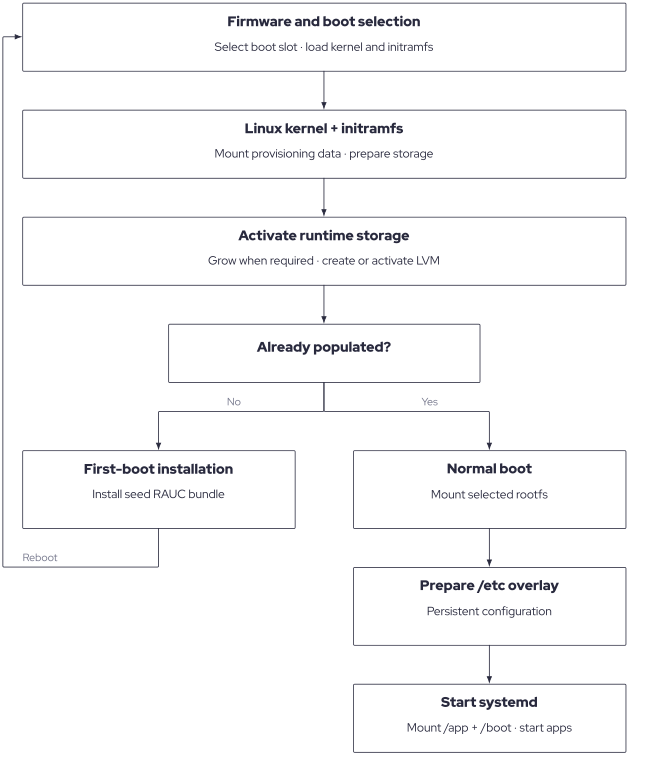
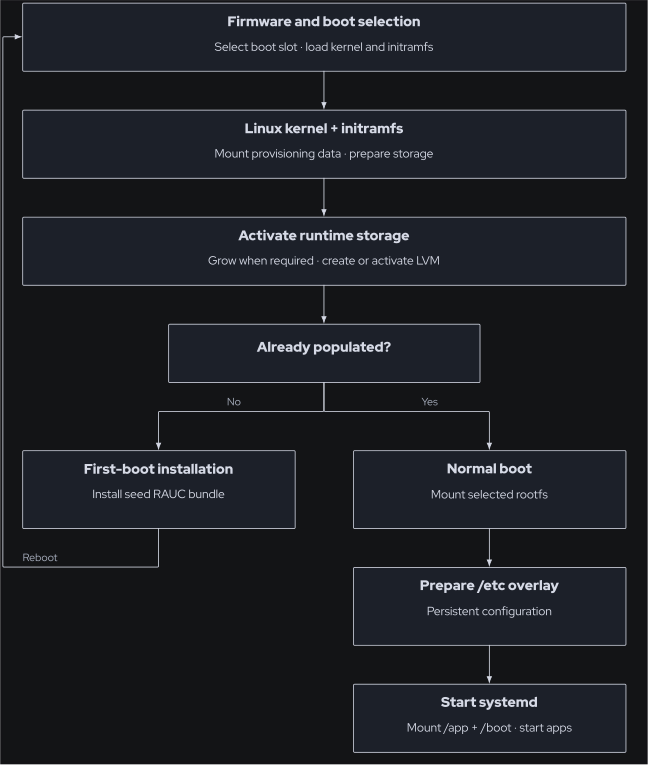
Reference rootfs-on-LVM startup. First-boot bundle installation takes a separate path and reboots; normal startup continues to the selected system. Optional storage encryption is unlocked before LVM is used.
Booting Process on EIG Hardware
The BSP signing features select signed bootloader and kernel artifacts. HAB4 applies to the i.MX8M EIG platforms; AHAB applies to EIGXS/i.MX93. A provisioned device anchors verification in its matching fused trust material and secure lifecycle state. An unfused development device is not equivalent to an authenticated production boot chain.
EIG-M / EIG-M-DIN / EIG-MA (HAB4)
  ROM -> authenticated boot container / U-Boot
      -> signed kernel boot path -> initramfs -> selected rootfs

EIG-XS (AHAB)
  ROM / ELE -> authenticated boot container / U-Boot
            -> signed OS container [kernel + DTB + initramfs]
            -> selected LVM rootfs
On EIGXS, INITRAMFS_IMAGE_BUNDLE = "0" because the initramfs is a separate
image inside the signed AHAB OS container. AHAB_INCLUDE_INITRAMFS controls
its inclusion. The board describes the container image layout and load
addresses through AHAB_OS_CONTAINER_CONFIG. The signing-data directory
supplies the selected keys and signing configuration through SIG_DATA_PATH.
Do not infer rootfs authentication or encrypted boot from kernel signing.
The reference RAUC verity bundle format verifies an update bundle; it does
not by itself enable dm-verity on the running root filesystem. Storage
confidentiality, when selected, is supplied by Extended Security.
For signing material, SRK programming, and device closing, see
Signing Keys Generation.
U-Boot Environment Protection
The reference EIG-M, EIG-M-DIN, EIG-MA, and EIG-XS manifests enable
uboot-hardened by default. The common i.MX KAS configuration includes the
BSP’s ci/fragments/hardened.yml, which selects the hardened U-Boot
configuration without an additional extension layer.
U-Boot first loads its compiled-in environment, then accepts only explicitly
allowed overrides from the saved environment. This provides a read-only
baseline for persistent boot policy, including bootcmd, while keeping the
state needed for A/B updates writable. For the default A/B slot names, the
writable overrides are:
Variable |
Flags |
Purpose |
|---|---|---|
|
|
Preferred slot order. |
|
|
Remaining boot attempts for slot A. |
|
|
Remaining boot attempts for slot B. |
The BSP defines this list in ENV_FLAGS_LIST and compiles it through
CONFIG_HARDENED_ENV_FLAGS_LIST_STATIC. Its hardened.cfg.in enables
CONFIG_ENV_WRITEABLE_LIST and CONFIG_ENV_APPEND so that loading saved
state preserves the built-in baseline. CONFIG_ENV_ACCESS_IGNORE_FORCE
prevents the force option from bypassing environment access checks.
Protection applies to values imported from persistent storage. Boot commands continue to set temporary variables in RAM, and the environment storage remains writable so that U-Boot and RAUC can save slot order and retry counters. A value written to storage outside the allowlist does not override the protected default when U-Boot reloads the environment. Changes to protected boot policy are delivered through an updated bootloader build.
This policy applies to the hardened EIG configuration. The reference QEMU
U-Boot manifests do not select uboot-hardened; the QEMU UEFI configuration
uses EFI variables for slot selection. Environment protection and device
secure-boot enforcement are separate mechanisms; see
OrchestraOS Security Architecture.
Initramfs and Userspace Handoff
The OrchestraOS initramfs mounts the provisioning filesystem, grows the storage partition when required, and creates or activates the logical volumes. Feature layers can prepare an encrypted backing device before the shared LVM modules run. The first-boot population step installs the seed bundle before normal operation begins.
Once the selected rootfs is mounted, its pre-init wrapper prepares the
persistent /etc overlay before invoking systemd. Runtime mount units
select the matching /app and /boot filesystems. Applications must
start after any mounts they require. The overlay directories and
persistence policy are described in Persistent /etc Overlay.
First-Boot Provisioning
A rootfs-on-LVM disk image carries a RAUC bundle in its first boot partition. The early boot flow populates the runtime logical volumes from that bundle; copying the WIC to a disk does not itself create populated rootfs logical volumes.
.lvm_created.done on /data-unencrypted records completed LVM creation.
A separate .lvm_populate.done records completed bundle installation. These
markers have different purposes and must not be treated as interchangeable.
A creation marker with an unreadable volume group causes recovery to stop
rather than reinitialize storage. The Initramfs LVM Policy Hooks allow feature
layers to place additional guards around growth, initialization, and cleanup.
The population module locates boot_A on ORCOS_DISK_DEVICE, finds a
.raucb seed bundle there, and fails if none is available. In the U-Boot
reference flow, installation populates the other slot and reboots into it.
In the EFI flow, the bundle is first staged off the boot partition, RAUC
provisions the first slot, and EFI entries are created for A and B. Initial
EFI BootOrder selects A; subsequent boots maintain the entries without
unconditionally resetting the active slot selection.
EFI slot entries include each rootfs device and rauc.slot argument.
The VM’s writable firmware variable store must persist between boots.
Recreating it loses boot entries and selection state; see
Virtual Platforms.
Subsequent Boots
After provisioning, initramfs activates existing storage and skips creation or
population according to the completion markers. RAUC installs later updates
into the inactive slot group. U-Boot tracks BOOT_ORDER and
BOOT_A_LEFT / BOOT_B_LEFT with three attempts by default, decrements an
attempt before boot, and falls back when the selected slot has no attempts left.
EFI uses its own RAUC backend and firmware selection state; the U-Boot retry
counter description does not apply to that backend.
Project health policy and persistent-state compatibility are covered in RAUC Update Flow.
Initramfs LVM Policy Hooks
The initramfs-module-lvm-grow and initramfs-module-lvm-create packages own
partition growth, LVM creation, filesystem initialization, and the completion
marker. Optional packages can add policy files without replacing these packages,
their files, or their shell functions.
initramfs-framework-orchestra advertises LVM_HOOKS_API = "1".
LVM_HOOKS_DIR defaults to /etc/lvm-hooks.d. Files in each event directory
are sourced in filename order in the initramfs shell:
Event |
When it runs |
Policy control |
|---|---|---|
|
After detecting a misplaced GPT backup header, before changing the disk |
Abort if growth is unsafe |
|
Before inspecting or initializing the configured LVM device |
Validate storage; optionally set |
|
Before destructive LVM cleanup, including failure recovery |
Set |
The two policy flags default to 1 for each operation. With no hook files,
signature removal and cleanup retain their existing behavior. Existing volume
groups with .lvm_created.done continue to skip initialization. No disk format,
volume name, or completion-marker path changes are required.
If the completion marker exists but the volume group cannot be read, boot stops
for recovery instead of attempting to initialize storage again.
Hooks must explicitly check command failures and call lvm_fail when an
operation must not continue. Returning a nonzero status from a sourced hook
also aborts boot. lvm_fail exits even if fatal returns, preventing the failed
operation from continuing. Hooks share shell state, so use a feature-specific
prefix for their own variables and functions.
For example, a project-specific storage policy package can install:
# /etc/lvm-hooks.d/before-cleanup/10-storage-policy
LVM_CLEANUP_ALLOWED=0
The base modules still perform the LVM operations. They handle command failures
explicitly and flush initialized storage before persisting the completion marker.
Feature layers prepare their storage device before 08-lvm_create and
supply any additional policy guards. Extension-specific implementation and
configuration are documented in the respective layer’s README.md.